Yan Kerrand
Winter in SokchoYan Kerrand is a French comics artist whose temporary stay at Old Park’s Guest House in Sokcho brings his work into contact with the narrator’s world. As he tries to move beyond a story centered on his recurring hero, he draws the town in spare ink and makes its light, spaces, and landscapes part of his visual language. His eventual departure leaves the narrator with a sketchbook whose images open onto a story that seems to dissolve even as it takes shape.
Identity and Arrival
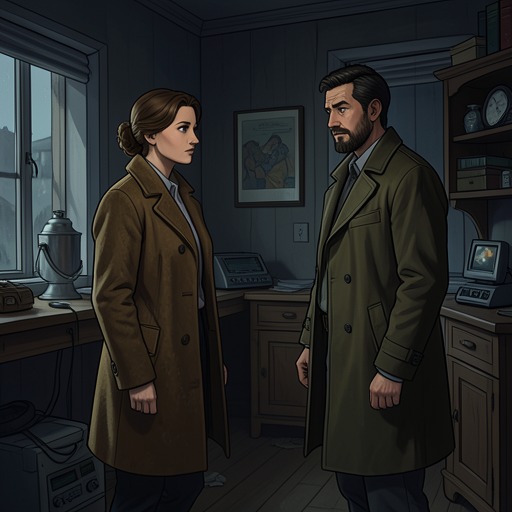
Kerrand arrives muffled in a woollen coat, sets his suitcase at the narrator’s feet, and removes his hat. The narrator notices his dark eyes, hair combed to one side, and a face that seems younger and less hollow than the photograph in his passport. He looks straight through the narrator without seeing her, then asks in English whether he can stay for a few days while he looks for something else. Rather than fill out the registration form himself, he hands over his passport; it identifies him as Yan Kerrand, born in 1968 and from Granville, France.
At the reception counter, he removes his gloves and inspects the dust and the cat figurine above the computer. His attention makes the narrator feel compelled to excuse the guest house’s run-down condition, although she has worked there for only a month. The first encounter thus establishes a distance between them: he arrives as an observant stranger, while she is already conscious of being observed and of the place she represents.
The Artist and His Reputation
When the narrator asks what he does, Kerrand says that he draws comics. The word does not match the narrator’s expectations of conventions and queues of fans, and she wonders whether he is famous. She later searches for him: a Korean search engine yields no information, but google.fr leads her to pages about his books. He signs his work Yan, and the tenth and final volume of his best-known series is due the following year.
The series follows a globe-trotting archaeologist, with each volume set in a different location and rendered as a monochrome ink-wash journey. It contains no dialogue and very few words. Its lone hero resembles Kerrand: sometimes a lumbering giant who dwarfs the other figures, sometimes a small figure whose features remain distinct while surrounding people disappear into details such as a chair, a stone, or a leaf. The contrast between the sharply legible protagonist and the shadow-like world around him gives the narrator a glimpse of the visual system Kerrand has made his own.
A publicity photograph shows Kerrand receiving a prize beside a red-haired woman nearly his height, with a square face and short hair. The narrator wonders whether the woman is a publicist or his wife, but the photograph does not answer her. She decides that the woman does not resemble the figure Kerrand had drawn: that drawn woman had softer lines. The narrator’s uncertainty matters more than any confirmed account of Kerrand’s private life; the available image gives her questions, not answers.
Drawing Sokcho
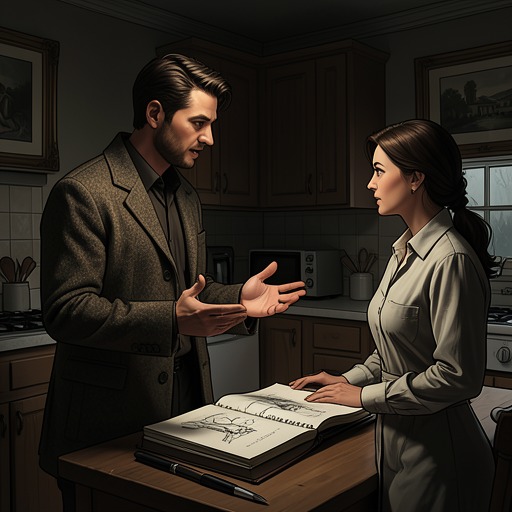
Kerrand asks the narrator whether Sokcho might make a good setting for a story. When she answers that it depends on the story, he asks her to help by showing him things. The request makes the narrator a guide to the town as well as an observer of his work. In the drawings she sees his hero arriving in a town, alongside recognizable Sokcho hotels, a frontier rendered as a scribble of barbed wire, and a cave with Buddhas. Places from her everyday surroundings have entered the imagined world of his series, transformed into shades of grey.
Kerrand draws the hero with the assurance of someone who knows the strokes by heart and can manipulate forms with closed eyes. He does not see a point in using colour. When the narrator doubts this response because Sokcho is so colourful, he points to a snowy mountaintop beneath a high sun: only a few lines outline the rocks, while most of the page remains blank. He explains that light shapes what is seen. The narrator then finds that the page’s force lies not in the ink but in the white space between its lines: the snow seems to burst from the paper, and the frames appear to blur and distort, as if the hero were struggling against their limits. In her reading, time expands inside the panels.
This exchange reveals a difference in how the two characters first understand a landscape. The narrator thinks of Sokcho through its abundance of colour; Kerrand builds the scene from outlines and emptiness. Yet the page does not simply remove the place’s vividness. Its blankness makes the snow palpable to the narrator, showing how a restricted palette can intensify what the image asks its viewer to see.
The Hero and the Limits of Control
The narrator has also seen Kerrand drawing alone through a half-open door. On the page, a bare-breasted woman lies curled on a futon; he fills in the wooden floor and the futon before turning to her face. As he gives her eyes and then a mouth, she sits upright and laughs with a sound the narrator judges too deep for a woman. Kerrand knocks over the inkpot. Ink runs between the woman’s lips, blacking her out until she vanishes. The scene turns a carefully worked drawing into an image that cannot be held in place: the artist’s hand brings the figure toward life, but the spilled ink erases her.
Later, Kerrand admits that he has been too wrapped up in his hero for far too long. The remark connects his work on the series to the difficulty of moving beyond its established protagonist, though the evidence does not specify what he intends to make next. In the drawings the narrator sees, control and uncertainty coexist: the familiar hero is rendered with practiced fluency, while the frames seem to strain and the woman disappears beneath an accident of ink.
Departure and the Sketchbook
Kerrand’s stay ends when he tells the narrator he has decided to return to France and will leave in four days. He says he will not waste any more of her time, then goes back to his room. His departure is presented as a decision to leave Sokcho, not as a completed solution to the difficulty he has described. The narrator curls up under the covers after he has gone, registering the news through its immediate effect on her.
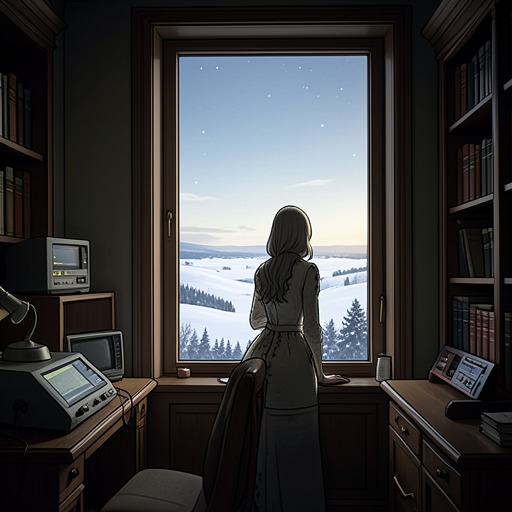
Afterward, the narrator opens the sketchbook he left behind. Its large, wordless frames show his hero and a heron standing together on a winter shore, looking toward the sea, with the snow-covered mountain behind them. The old, one-legged, silver-feathered bird is rendered as a beautiful presence; water spurts from its beak and becomes a river that feeds the ocean. These images extend the visual language Kerrand has shown her, but their scale and stillness give the sketchbook a different register from the compact scenes of the series.
As the pages continue, faceless, ageless people leave faint yellow and blue traces in wet sand. The sea spreads beyond the beach and into the sky until the image has no drawn lines, only the edges of the page to contain it. The narrator understands the place as both taking shape and dissolving, a threshold where falling snow meets sea spray. The story then fades: the heron’s eyes are closed, the paper turns blue, and the man moves passively beneath the waves. In his wake appear fragments of a woman’s body—a shoulder, belly, breast, and lower back—whose lines taper to a fine ink thread and a scar. The sketchbook does not supply a plain verbal explanation of these images; instead, its changing frames leave the narrator with a visual story whose meanings remain in motion.
Narrative Significance
Kerrand’s role in the narrative is shaped by the distance between his public identity as an accomplished artist and the uncertain work taking form during his stay. The narrator discovers the scale and visual rules of his series only after he has arrived, and then watches Sokcho enter those rules as a frontier, a town, a cave, and a field of snow. His request that she show him things makes her local knowledge part of the encounter, while his drawings return familiar places to her in a newly estranged form.
The sketchbook carries that exchange beyond Kerrand’s departure. Its shift from monochrome, practiced lines toward blue pages, colour traces, and images without internal borders makes the story feel less like a finished sequence than a passage between states. Kerrand’s work therefore gives the narrator not a definitive account of his intentions, but a changing surface on which place, memory, and the limits of representation can be seen—and then lost again.